
BMW VANOS Problems and Their Solutions: Symptoms, Causes, Diagnosis & Repair Guide
A smooth-running BMW engine depends on precise valve timing. The VANOS system plays a key role in achieving that precision. When it starts to malfunction, you may notice rough idling, reduced power, poor fuel economy, hesitation during acceleration, or a check engine light. These symptoms often resemble ignition, timing chain, or fuel system problems, making an accurate diagnosis essential.
This guide explains the most common BMW VANOS Problems and Their Solutions. It also covers warning signs, common causes, affected BMW engines, fault codes, and the best repair options. Understanding these issues early can help prevent unnecessary repairs and maintain your BMW’s performance.
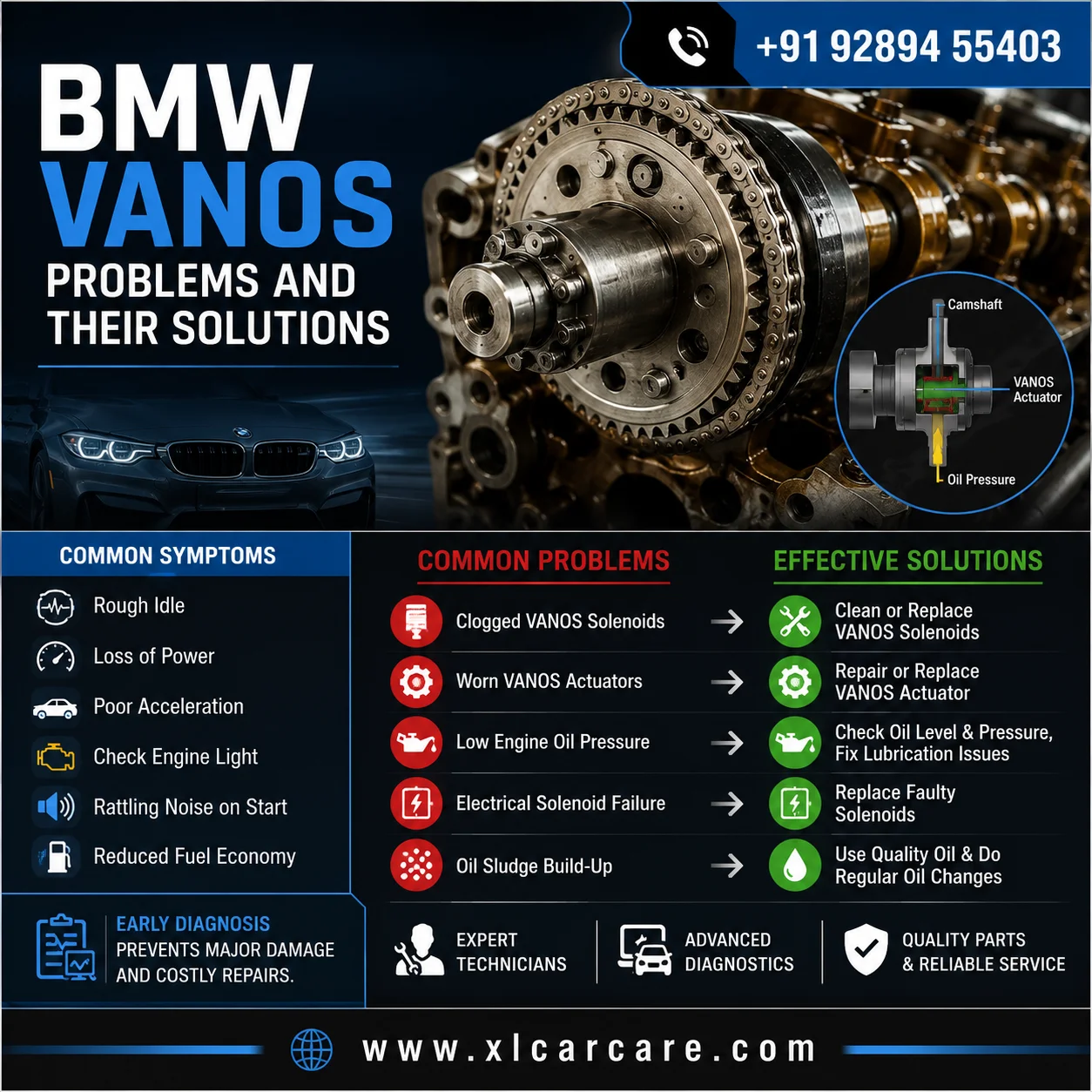
What Is the BMW VANOS System?
The VANOS system is BMW’s variable valve timing technology. It adjusts the timing of the intake and exhaust camshafts according to engine speed and load. This allows the engine to deliver smoother acceleration, better fuel efficiency, improved torque, and lower emissions.
The system mainly consists of:
- VANOS solenoids
- Camshaft actuators
- Engine oil passages
- Engine Control Unit (ECU)
- Camshaft position sensors
The ECU controls the VANOS solenoids. These solenoids regulate engine oil pressure to move the camshaft actuators. As valve timing changes, the engine performs efficiently under different driving conditions.
If oil flow becomes restricted or a component fails, the VANOS system cannot adjust valve timing correctly. This is when BMW VANOS problems begin to appear.
Common BMW VANOS Problems
Several issues can affect the VANOS system over time. Some develop gradually, while others trigger sudden drivability problems.
1. Clogged VANOS Solenoids
Dirty engine oil can leave deposits inside the solenoid screens. Restricted oil flow slows down actuator movement and causes incorrect valve timing.
2. Worn VANOS Actuators
High-mileage BMW engines may develop wear inside the actuator gears or seals. This reduces timing accuracy and affects engine performance.
3. Low Engine Oil Pressure
The VANOS system depends on hydraulic oil pressure. Low oil level, incorrect oil grade, or internal oil pressure problems can reduce system performance.
4. Electrical Solenoid Failure
The solenoid coil may fail because of age or heat exposure. A faulty solenoid cannot respond correctly to ECU commands.
5. Oil Sludge Build-Up
Extended oil change intervals allow sludge to accumulate. This blocks oil passages and limits VANOS operation.
Symptoms of BMW VANOS Problems
BMW VANOS Problems and Their Solutions start with identifying the correct symptoms. Many of these signs overlap with other engine faults, so proper diagnosis is important.
- Rough idle
- Loss of engine power
- Poor throttle response
- Reduced fuel economy
- Engine hesitation during acceleration
- Cold start rattling noise
- Engine vibration
- Misfire under load
- Hard starting
- Check Engine Light
- Reduced low-end torque
- Irregular engine RPM
- Sluggish acceleration
- Metallic ticking sound after startup
Ignoring these symptoms may allow additional engine components to wear prematurely.
Early Warning Signs You Should Not Ignore
Some VANOS problems begin with very mild symptoms.
- Slight hesitation during city driving
- Engine feels less responsive
- Small RPM fluctuations at idle
- Occasional cold-start noise
- Reduced fuel efficiency without another obvious cause
Early diagnosis often prevents more expensive repairs later.
What Causes BMW VANOS Problems?
Several factors contribute to VANOS failure. Regular maintenance significantly reduces these risks.
- Old or contaminated engine oil
- Using incorrect oil viscosity
- Extended oil service intervals
- Dirty VANOS solenoid filters
- High engine mileage
- Oil pressure issues
- Internal actuator wear
- Oil sludge formation
- Overheating
- Poor maintenance history
Routine servicing with the correct BMW-approved engine oil helps keep the VANOS system operating correctly.
BMW Engines Commonly Affected
Although VANOS technology has been used for many years, some BMW engine families experience these problems more frequently.
| BMW Engine | Common VANOS Concern |
|---|---|
| N52 | Solenoid contamination and actuator wear |
| N54 | Oil contamination affecting solenoid response |
| N55 | Sticky VANOS solenoids and reduced oil flow |
| B58 | Less common but possible with poor maintenance |
| S55 | Higher stress from performance driving |
These engines are commonly found in various BMW 1 Series, 3 Series, 5 Series, X3, X5, X6, and M models.
Common BMW VANOS Fault Codes
Fault codes alone do not confirm VANOS failure. However, they provide valuable diagnostic direction.
| Fault Code | Possible Meaning |
|---|---|
| 2A82 | Intake VANOS control fault |
| 2A87 | Exhaust VANOS control fault |
| P0012 | Camshaft timing over-retarded |
| P0015 | Exhaust camshaft timing issue |
| P0016 | Camshaft and crankshaft correlation fault |
| P0017 | Exhaust camshaft correlation problem |
Professional diagnostic equipment is recommended to confirm the root cause. Similar codes may also appear due to timing chain wear, camshaft sensor faults, or oil pressure problems.
How BMW VANOS Problems Are Diagnosed
Accurate diagnosis is the most important step. Replacing parts without testing often increases repair costs.
A qualified BMW technician generally performs the following checks:
- Scan BMW-specific fault codes.
- Review live VANOS adaptation values.
- Test intake and exhaust VANOS solenoids.
- Inspect engine oil condition and service history.
- Measure solenoid electrical resistance.
- Check oil pressure.
- Inspect camshaft timing values.
- Rule out timing chain or Valvetronic issues.
If your BMW shows multiple engine performance symptoms, advanced diagnostics are usually more reliable than replacing ignition coils, sensors, or other parts without confirming the actual fault. For accurate fault detection, professional BMW diagnostic testing can identify whether the VANOS system is responsible. In some cases, technicians may also inspect related components such as the timing chain or recommend inspection using genuine BMW parts if replacement becomes necessary.
Can You Drive With a Bad VANOS System?
You may still be able to drive your BMW for a short distance if the VANOS system starts failing. However, it is not recommended to ignore the problem. Incorrect valve timing can reduce engine efficiency and increase stress on other components.
Driving with a faulty VANOS system for an extended period may lead to:
- Poor engine performance
- Higher fuel consumption
- Increased engine emissions
- Frequent engine misfires
- Damage to related engine components
If the Check Engine Light appears along with rough idling or loss of power, arrange a professional inspection as soon as possible.
BMW VANOS Problems and Their Solutions
The correct repair depends on the actual cause of the failure. Replacing parts without proper testing may not solve the issue.
| Problem | Recommended Solution |
|---|---|
| Dirty VANOS solenoids | Clean or replace the solenoids |
| Oil sludge | Engine oil and filter replacement using BMW-approved oil |
| Faulty solenoid | Replace the defective intake or exhaust solenoid |
| Actuator wear | Repair or replace the VANOS actuator assembly |
| Oil pressure issue | Inspect the lubrication system and repair the root cause |
| Timing chain concern | Inspect timing components before replacing VANOS parts |
In many cases, replacing clogged solenoids and performing a complete oil service restores proper VANOS operation. High-mileage engines with internal wear may require additional repairs.
VANOS vs Timing Chain vs Valvetronic
Many BMW owners confuse these systems because their symptoms often overlap.
| System | Main Function | Common Symptoms |
|---|---|---|
| VANOS | Controls valve timing | Rough idle, hesitation, power loss |
| Timing Chain | Synchronizes crankshaft and camshafts | Rattling noise, timing faults, engine damage if ignored |
| Valvetronic | Controls valve lift | Poor idle, reduced throttle response, limp mode |
Since these systems work together, professional diagnostics are essential before replacing expensive components.
How to Prevent BMW VANOS Problems
Good maintenance habits can significantly improve the life of the VANOS system.
- Use BMW-approved fully synthetic engine oil.
- Follow regular oil and filter replacement intervals.
- Check engine oil level regularly.
- Repair oil leaks without delay.
- Avoid delaying scheduled maintenance.
- Investigate engine warning lights promptly.
- Use quality replacement parts whenever repairs are required.
Preventive maintenance is usually more affordable than repairing engine damage caused by neglected servicing.
When Should You Visit a BMW Specialist?
Seek professional inspection if your BMW develops any of these symptoms:
- Persistent Check Engine Light
- Cold-start rattling
- Loss of acceleration
- Engine hesitation
- Repeated VANOS fault codes
- Rough idle after routine servicing
BMW engines require specialized diagnostic equipment and experienced technicians. Proper testing helps identify the real cause instead of replacing multiple parts unnecessarily.
If your vehicle requires expert inspection, a dedicated BMW Repair and Service Center in Delhi NCR can accurately diagnose VANOS, timing, lubrication, and engine management issues. If replacement components are needed, using Original BMW Parts helps maintain long-term reliability.
Why Choose XL Car Care for BMW Diagnostics and Repairs?
BMW engine problems require accurate diagnosis, specialized tools, and experienced technicians. XL Car Care is a premium luxury car repair and service center that focuses on maintaining the performance, reliability, and driving experience of luxury vehicles.
Our team uses advanced diagnostic equipment and quality replacement parts to identify engine-related issues, including VANOS faults, timing concerns, oil pressure problems, and electronic system errors. Every inspection follows a systematic approach to reduce unnecessary repairs and identify the actual source of the fault.
XL Car Care
- Address: B2/31, Mohan Cooperative Industrial Estate, Badarpur, New Delhi, Delhi 110044
- Phone: 092894 55403
- Email: info@xlcarcare.com
- Working Hours: Monday to Saturday – 8:30 AM to 7:00 PM
- Sunday: Closed
- Google Maps: View Location
You can also book an appointment for a professional BMW inspection or contact our team for service-related assistance.
Frequently Asked Questions
Can a faulty VANOS system cause a Check Engine Light?
Yes. Incorrect valve timing can trigger fault codes related to camshaft position and engine performance.
Can dirty engine oil damage the VANOS system?
Dirty oil can restrict oil flow through the VANOS solenoids and reduce system efficiency over time.
Is VANOS failure common in BMW cars?
It is more common in higher-mileage BMW engines, especially if oil changes have been delayed or incorrect oil has been used.
Can VANOS problems affect fuel economy?
Yes. Incorrect valve timing can reduce combustion efficiency and increase fuel consumption.
Can I clean VANOS solenoids instead of replacing them?
If the solenoids are only contaminated and not electrically damaged, cleaning may restore normal operation. A technician should confirm their condition before deciding.
How are BMW VANOS problems diagnosed?
Diagnosis usually includes fault code scanning, live data analysis, oil pressure inspection, electrical testing, and checking camshaft timing values.
Does every rough idle indicate a VANOS problem?
No. Rough idling may also result from ignition faults, vacuum leaks, fuel delivery issues, or timing chain wear. Proper diagnostics identify the exact cause.
Conclusion
Understanding BMW VANOS Problems and Their Solutions helps you recognize early warning signs before they develop into expensive engine repairs. Symptoms such as rough idling, hesitation, cold-start rattling, and reduced power should never be ignored.
Timely diagnosis, regular oil changes, and professional servicing are the best ways to maintain reliable engine performance. If your BMW shows signs of a VANOS-related fault, a detailed inspection using BMW-specific diagnostic equipment can identify the issue accurately and help restore smooth, efficient operation.