
Your Audi’s braking system is designed for precision, safety, and confidence. Every time you press the brake pedal, brake fluid transfers hydraulic pressure to the braking components. This allows your car to stop smoothly and safely.
Many Audi owners focus on engine oil, filters, and tyres but overlook brake fluid. Unlike some maintenance items, brake fluid wears out with time, not just mileage. Even if you drive your Audi only occasionally, the fluid continues to absorb moisture from the air.
Following the recommended Audi brake fluid change interval helps maintain braking performance, protects hydraulic components, and supports the proper operation of ABS and electronic stability systems.
If you are already following your Audi service intervals, adding brake fluid replacement at the correct time is an important part of preventive maintenance.
What Is Brake Fluid?
Brake fluid is a hydraulic fluid that transfers force from the brake pedal to the braking system. Without healthy brake fluid, your Audi cannot generate the hydraulic pressure needed for safe braking.
The fluid also supports the proper operation of important safety systems such as:
- Anti-lock Braking System (ABS)
- Electronic Stability Control (ESC)
- Emergency Brake Assist
- Traction Control System
Because brake fluid operates under high temperatures and pressure, its condition directly affects braking performance.
What Is the Recommended Audi Brake Fluid Change Interval?
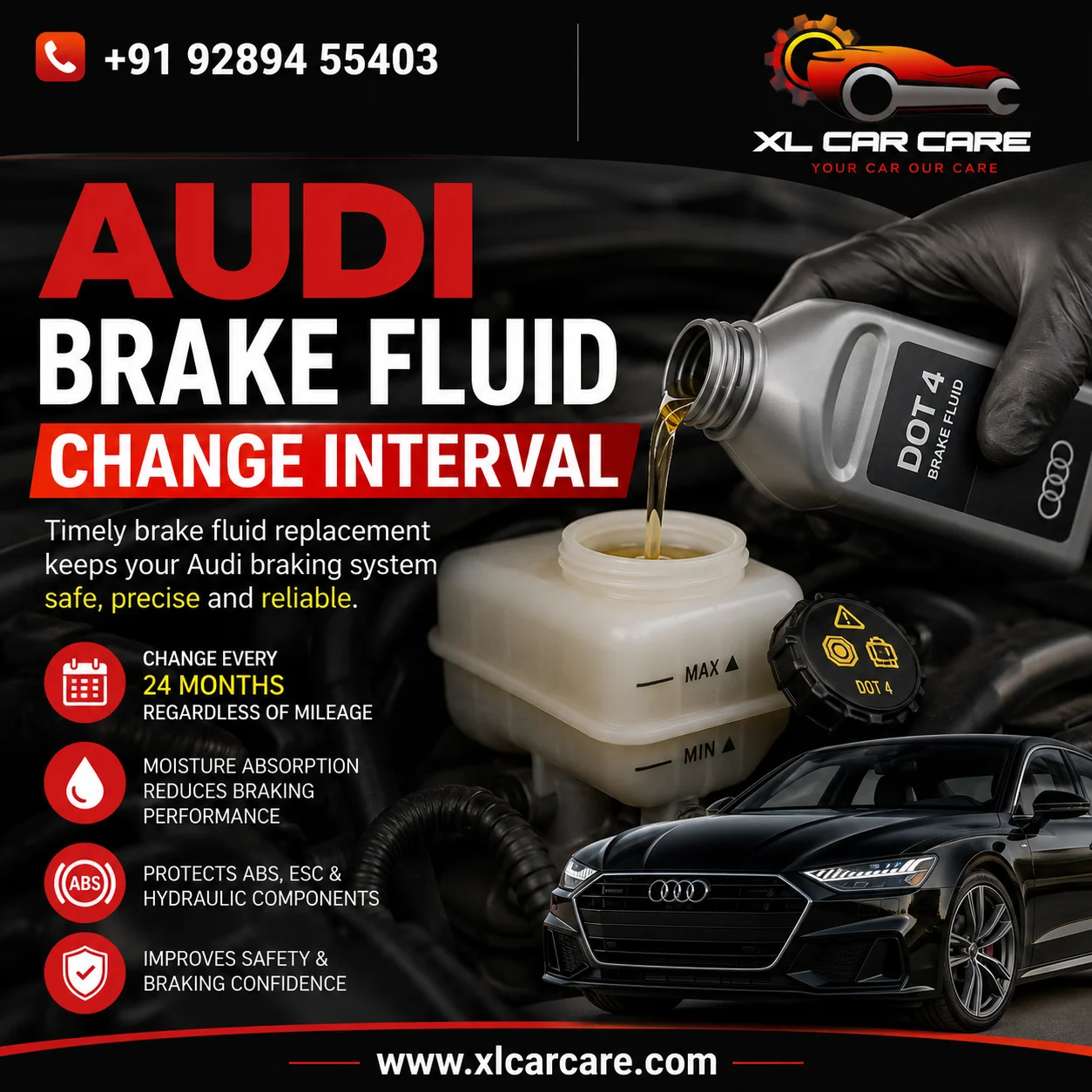
For most modern Audi models, the recommended brake fluid replacement interval is every 24 months, regardless of mileage. This recommendation applies because brake fluid naturally absorbs moisture over time.
Even if your Audi has covered only a few thousand kilometres, the fluid may still require replacement after two years.
This recommendation generally applies to models including:
- Audi A3
- Audi A4
- Audi A5
- Audi A6
- Audi A7
- Audi A8
- Audi Q3
- Audi Q5
- Audi Q7
- Audi Q8
- Audi e-tron models
Your owner’s manual remains the best source for the exact maintenance schedule for your specific model and model year.
Why Does Audi Recommend Brake Fluid Replacement Every Two Years?
The answer lies in the chemical properties of brake fluid.
Most Audi vehicles use glycol-based brake fluid. This type of fluid is hygroscopic, which means it gradually absorbs moisture from the surrounding air.
As moisture enters the brake fluid, several problems can develop.
- The boiling point of the fluid decreases.
- Brake performance may reduce during repeated braking.
- Hydraulic components become more vulnerable to internal corrosion.
- ABS components can be affected by contaminated fluid.
- Brake pedal feel may become softer.
Replacing brake fluid at the recommended interval helps prevent these issues before they affect braking performance.
How Moisture Affects Your Audi’s Braking System?
Fresh brake fluid has a high boiling point. During heavy braking, the braking system generates significant heat. Healthy brake fluid continues to transfer pressure efficiently under these conditions.
As moisture contamination increases, the boiling point gradually drops.
If the fluid becomes hot enough, small vapour bubbles can form inside the hydraulic system. Unlike brake fluid, these bubbles compress under pressure.
This may lead to:
- Soft or spongy brake pedal
- Reduced braking confidence
- Longer stopping distance
- Brake fade during repeated braking
Although these symptoms may not appear immediately, regular brake fluid replacement helps reduce the risk of moisture-related problems.
Signs Your Audi Brake Fluid May Need Replacement
Your vehicle may show several warning signs when brake fluid has deteriorated.
- Brake pedal feels soft or spongy.
- The car takes longer to stop.
- Brake response feels inconsistent.
- Brake warning light appears.
- ABS warning light comes on.
- Brake fluid looks dark instead of clear.
- Burning smell after heavy braking.
- Reduced confidence during emergency braking.
These symptoms do not always indicate brake fluid alone. However, they should never be ignored. A professional inspection can identify the actual cause.
What Happens If You Ignore the Audi Brake Fluid Change Interval?
Skipping brake fluid replacement may increase wear inside the hydraulic braking system over time.
The process usually develops gradually.
- Brake fluid absorbs moisture.
- Its boiling point reduces.
- Hydraulic efficiency decreases.
- Brake pedal feel changes.
- Internal corrosion may begin.
- Sensitive components such as the ABS hydraulic unit may become vulnerable to contamination.
Replacing brake fluid on schedule is generally less expensive than repairing damaged hydraulic components.
Which Brake Fluid Does Audi Use?
Many Audi models use high-quality DOT 4 brake fluid. Some newer vehicles may require DOT 4 Low Viscosity (LV) fluid to support advanced ABS and electronic braking systems.
Using the correct specification is important because different brake fluids have different chemical properties and performance characteristics.
| Brake Fluid Type | Typical Application |
|---|---|
| DOT 4 | Many standard Audi models |
| DOT 4 LV | Vehicles with advanced electronic brake systems |
| DOT 5.1 | Specific high-performance applications where recommended by the manufacturer |
Always follow the specification mentioned in your owner’s manual or consult experienced Audi technicians before replacing brake fluid.
How Is Brake Fluid Tested?
Replacing brake fluid should not be based only on its colour. Professional workshops use proper inspection methods to assess its condition.
Brake fluid testing may include:
- Visual inspection for contamination.
- Checking the fluid colour.
- Moisture content testing.
- Inspecting the brake fluid reservoir.
- Checking for leaks in the hydraulic system.
At XL Car Care, every Audi is inspected carefully before maintenance begins. The workshop specialises in luxury vehicle servicing using modern diagnostic equipment and manufacturer-recommended service procedures. Genuine-quality parts and careful workmanship help maintain the performance and reliability expected from premium vehicles.
If your Audi requires a detailed inspection or scheduled maintenance, experienced technicians at the Audi Repair and Service Center in Delhi NCR can inspect the complete braking system along with other essential maintenance items.
Driving conditions in India can place additional demands on your Audi’s braking system.
Factors that may increase brake usage include:
- Stop-and-go city traffic.
- High summer temperatures.
- Monsoon humidity.
- Frequent downhill driving.
- Heavy urban congestion.
These conditions make it even more important to follow the recommended Audi brake fluid change interval instead of waiting until braking performance changes.
Regular maintenance, combined with periodic inspections, helps keep your Audi braking system operating as intended.
How Is Audi Brake Fluid Replaced?
Brake fluid replacement is more than simply topping up the reservoir. The old fluid needs to be completely flushed from the hydraulic system before fresh fluid is added.
A professional brake fluid service usually includes the following steps.
- Inspect the complete braking system.
- Check the brake fluid condition.
- Remove the old brake fluid safely.
- Flush the hydraulic system.
- Refill with the correct Audi-approved brake fluid.
- Bleed all brake lines to remove trapped air.
- Inspect the brake pedal feel.
- Road test the vehicle if required.
Modern Audi models may require specialised diagnostic equipment during the bleeding process, especially on vehicles equipped with advanced ABS and electronic braking systems.
Can You Replace Audi Brake Fluid Yourself?
Some experienced enthusiasts perform brake fluid replacement at home. However, modern Audi vehicles have sophisticated braking systems that require proper tools and correct bleeding procedures.
A DIY brake fluid replacement may carry certain risks.
- Air entering the brake lines.
- Incorrect brake fluid specification.
- Incomplete removal of contaminated fluid.
- Improper bleeding of the ABS hydraulic unit.
- Reduced braking performance after service.
For these reasons, brake fluid replacement is generally best carried out by technicians familiar with Audi braking systems.
Common Mistakes to Avoid During Brake Fluid Replacement
Even a small mistake can affect the braking system.
- Mixing different brake fluid specifications.
- Using contaminated brake fluid.
- Leaving air inside the hydraulic system.
- Skipping brake bleeding.
- Ignoring leaks around the master cylinder or brake lines.
- Overfilling the brake fluid reservoir.
Following the correct service procedure helps maintain consistent braking performance.
Brake Fluid Maintenance Checklist
| Maintenance Item | Recommended Action |
|---|---|
| Brake fluid level | Inspect during routine servicing. |
| Brake fluid condition | Check for contamination. |
| Brake fluid replacement | Every 24 months. |
| Brake hoses and lines | Inspect for leaks or damage. |
| ABS operation | Check during scheduled maintenance. |
| Brake pads and discs | Inspect regularly for wear. |
Along with brake fluid replacement, regular inspection of brake pads is equally important. If worn components are found during service, they should be replaced promptly to maintain safe braking performance. You can learn more about Audi brake pad repair and when replacement may be required.
How XL Car Care Helps Maintain Your Audi Braking System?
XL Car Care is a luxury car repair and service centre located at B2/31, Mohan Cooperative Industrial Estate, Badarpur, New Delhi, Delhi 110044. The workshop specialises in servicing premium European vehicles, including Audi.
The team follows manufacturer-recommended service procedures and uses advanced diagnostic equipment to inspect critical vehicle systems. Every vehicle receives careful attention to help maintain safety, reliability, and driving performance.
During an Audi brake fluid service, technicians may inspect:
- Brake fluid condition.
- Brake lines.
- Master cylinder.
- Brake calipers.
- Brake hoses.
- ABS-related components.
- Brake pads and discs.
If additional maintenance is required, it can be identified during the inspection. Services such as Audi suspension repair, routine maintenance, and complete vehicle diagnostics are also available for Audi owners.
Frequently Asked Questions
How often should Audi brake fluid be changed?
Most Audi models require brake fluid replacement every 24 months, regardless of mileage. Always refer to your owner’s manual for your specific model.
Can brake fluid last five years?
Brake fluid gradually absorbs moisture over time. Delaying replacement for several years may reduce braking performance and increase the risk of internal corrosion.
Does mileage affect the Audi brake fluid change interval?
Time is generally more important than mileage because brake fluid absorbs moisture even when the vehicle is driven infrequently.
What type of brake fluid does Audi use?
Many Audi models use DOT 4 or DOT 4 Low Viscosity brake fluid. Always use the specification recommended for your vehicle.
How long does a brake fluid replacement take?
The service time varies depending on the model and workshop procedure. A professional inspection can provide a more accurate estimate.
Can old brake fluid affect ABS performance?
Contaminated brake fluid may affect hydraulic efficiency. Regular replacement helps support the proper operation of ABS and other braking systems.
Should brake pads be inspected during brake fluid replacement?
Yes. Brake pads, discs, hoses, and other braking components are commonly inspected during scheduled brake maintenance.
Conclusion
Following the recommended Audi brake fluid change interval is an important part of responsible vehicle maintenance. Fresh brake fluid helps maintain hydraulic pressure, supports ABS performance, and protects important braking components from moisture-related wear.
Although brake fluid replacement is scheduled every two years for most Audi models, routine inspections remain equally important. Identifying contamination or developing braking issues early can help prevent more extensive repairs in the future.
If your Audi is due for brake fluid replacement or a scheduled inspection, choosing technicians experienced with premium European vehicles can help ensure the correct service procedures and brake fluid specifications are followed.
XL Car Care
B2/31, Mohan Cooperative Industrial Estate,
Badarpur, New Delhi, Delhi 110044
Phone: 092894 55403
Email: info@xlcarcare.com
Working Hours: Monday to Saturday: 8:30 AM – 7:00 PM
Sunday: Closed
To schedule an inspection or routine maintenance, you can also visit the Book an Appointment page or explore the Audi service cost guide to understand your maintenance requirements better.